Pecha Kucha
Pecha Kucha was a topic discussed during the lesson which involves people presenting work on a slide show where the presenters each get 20 seconds to comment and inform people about the slide. The slides can consist of images, videos & quotes. It was introduce in February 2003 by Tokyo Architects Astrid Klein & Mark Dytham,


Pecha kucha is the Japanese word for chatter and it's a simple presentation format which keeps presentations concise, fast paced, and entertaining. The first pecha kucha night was held in the gallery club creative kitchen called super deluxe and has since become a worldwide phenomenon.
---------------------------------------------------------------------------------------------------------------------------
 Henri cartier Bresson
 Born 1908, in Chanteloupe France
Regarded as one of the greatest photographer of his time, he had the ability to wait around for that special shot of ordinary everyday things caught within the decisive moment. Henri Cartier-Bresson was born in 1908, in Chanteloupe, France as a young boy he owned a box brownie which he used for holiday snaps, and then later he moved to a 3X4 view camera which he started experimenting with. His first monumental 'The Decisive Moment' was the first photographic exhibit to be displayed in the halls of the louvre.
it seems that he had a sixth sense and was able to predict what was going to happen before it did happen and he was always ready to capture that moment.


Henri Cartier Brasson once quoted:
"I prowled the streets all day, feeling very strung-up and ready to pounce, determined to ‘trap’ life, to preserve life in the act of living"
---------------------------------------------------------------------------------------------
Photographing a Perfume Bottle
We were set a task to photograph a perfume bottle in different light sources, I went in the studio first to shoot the bottle with flash lighting and the photograph is not as good as i thought it would be as you can see where the flash as hit the box and reflected back leaving a bright spot.

Then i did tungsten lighting which was different the lighting seemed very even and bright although i do think that better positioning of the bottle could have helped more although it has to be my favourite for overall lighting here is my outcome for tungsten lighting.

Then i did fluorescent lighting now this photograph seems really dark and has a very blue tint to it and it does not show the detail as good as other lighting sources, here is the result for fluorescent lighting.

Last of all was daylight this to me was a good result apart from where the light is hitting the box it seems to be similar to the flash picture and could have been better had i thought about the were the sun was and the positioning of the bottle, if i was to do this again i would certainly make sure i had more time to get better practise out of it as the hour just didn't seem long enough to think about the lighting and positioning of the bottle for taking these four shots. Although this is my favourite one out of them all and this is the result for my daylight photo.

Results after our tutor showed us the best techniques to use for photographing perfume bottles with the use of 45 degree lighting, reflectors and under lighting. As you can see there is a lot more detail in these photos with the use of the under lighting it as enhanced the overall bottle, with the use of card it gives the bottle defining lines while enhancing the colours of the bottle and giving it character.


--------------------------------------------------------------------------------------------------------------------------
Portrait Lighting Techniques
Lights set to full power and at 1:1

Camera set to = Aperture - f22
Shutter speed - 1/500
ISO - 100

Camera set to = Aperture - f22
Shutter speed - 1/250
ISO - 100

Camera set to = Aperture - f22
Shutter speed - 1/125
ISO - 100

When using flash lighting by going 1 stop down it gives the following effects
1:2 =

1:4 =

1:8 =

Then with only 1 light on the left this is the result

-------------------------------------------------------------
Inverse Square Law
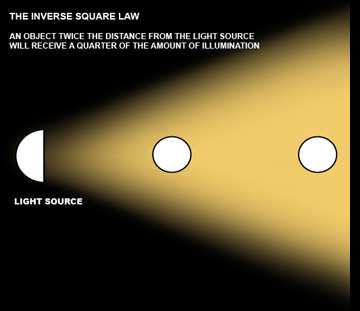
Basically an object that is twice the distance from a source point (flashgun or lamp) will receive a quarter of the light but if you move your subject between 3 meters to six meters away, you will need four times the amount of light for the same exposure. This can most easily be achieved by opening the lens aperture two f-stops or by simply using a flashgun that is four times as powerful. As you can see in the picture above the further away the subject the less light is able to hit it, as the light rapidly fans outwards from the source point and therefore gets weaker.
.
So if you were to move a correctly exposed subject 1 meter away from the light which is twice the distance, it will receive 1/4 times the light, and then it would result in being 2 stops under exposed.If you were to move a correctly exposed subject 2 meters away from the light half the distance, it will receive 4 times more light, and then it would be 2 stops over exposed.
If you were to move a correctly exposed subject 3 meters away from the light 1/81 the distance, it will receive 9 times more light, and then it would be 4 stops over exposed.

If you were shooting a model against a backdrop and you want the model to be correctly lit while the background dark. You would place the model away from the background and close to the light source. I enjoyed the task in all but i would have enjoyed it more if we had more time to think about the positioning and the effects the lighting had on photographing the bottle.
--------------------------------------------------------------------------------------------------------------
Personal Object


By moving the lights around and using a under light it seemed to give depth to the pictures, and the reflections that were created are very clear. In some of the photographs the car actually looks real, especially the ones where i got close to take the photo the detail they show if unbelievable. Using the lights in different always created a different picture while some had bold shadows, others had hardly any shadows. I also covered the under light with some red tissue paper and this made the picture a very warm colour which looked good. The overall task was very enjoyable and gives me a better idea as to how lighting can be used to make an object look really good.
---------------------------------------------------------------------------------------------------------------------------
Lights
Always check the wattage on the bulbs before starting; ensuring they are both set to the same output.
Examples of Good And Bad Lighting


Modifiers =
Reflectors - Harsh Shadow Circle
A reflector is any object used to bounce light—it could be a wall, a white shirt, a mirror, or a commercially purchased kit. This is one easy and effective way to control light. Unlike using flash for fill light; reflectors give you visual confirmation of where the light is. With reflectors, you can also set up and fine-tune your results more quickly than with flash. Additionally, you are not limited to the flash-sync speed of your camera.
A reflector is any object used to bounce light—it could be a wall, a white shirt, a mirror, or a commercially purchased kit. This is one easy and effective way to control light. Unlike using flash for fill light; reflectors give you visual confirmation of where the light is. With reflectors, you can also set up and fine-tune your results more quickly than with flash. Additionally, you are not limited to the flash-sync speed of your camera.
Umbrella - Nice light, and by putting the light close to the umbrella it gives dynamic lighting.
Beauty dish - Softens a more direct light and spreads highlights out more, without the shade on it becomes bolder.
Snoots - Give a very direct light, the soft silver surface on the inside produces soft light fall off around the circle light. While the black surface on the inside of the snoot eliminates the light off completely.
Gridspots - Grids differ from snoots in that they produce a much cleaner circle of light. The grids produce a very smooth, circular blob of light, very similar to a spotlight. Grids come in different sizes which refer to the size of the holes in it, with the higher numbered grids producing a tighter circle of light.
Enlarging the lighting softens shadows because a larger light source produces a more gradual transition between deep shadow and full illumination.
The most common misconception is that spreading the light over a wider area will soften the shadows. This is NOT the case. You must actually enlarge the light source to soften the shadows
Continuous lighting cannot be modified apart from taking the cover off the shade.
By dropping the levelling on the lights gives the subject more character
The closer the lights are to the subject the harder the shadows becomes.
The further away the light is the softer the shadows become.
Under lighting- by tilting the under light it defies the light more.
Ratio's = 1:1 basic lighting ratio
1:2 one side is half the power
1:4 the shadow on one side is prominent

Snoots
Barn doors
Flash Reflectors
Umbrellas
Grids


---------------------------------------------------------------------------------------------------------------------------
Objects Brief
Have You -
. Photographed your macro/close up image and are you happy with it?
Yes its complete and I am more than happy with it, I was able to get close enough to show a small
piece of cotton that was stuck to the object. Macro photography is photography magnified and it is generally recognised as “macro” when you are increasing the size of an object in your picture from about half life-size, as represented on the image sensor, to five times life-size. With its emphasis on detail, pattern, and texture, macro photography can yield rewarding and unique results. "Macro" lenses specifically designed for close-up work, with a long barrel for close focusing, are one of the most common tools for macro photography. It is recommend that you use a timed shutter release, as depressing the shutter release manually can produce unwanted blur to a macro photo. The use of a tripod is also recommended as to stop any camera shake.
Here are some of the images that I attempted to get to the image I finally chose.


. Attempted a mini set build?
Yes I managed to get a shot, after a number of attempts of different scenes, I decided to present the birds photograph. Here are a few of the images I considered for the mini build set.


. Photographed a product - a commercially viable one?
Yes I got my commercial shot although it could have been a little more in focus as it could have helped to make the picture look better, but considering it was spinning around continuously it made it difficult. I am happy with the finished image as I wanted to create an image that had modern colours and was eye catching, had dramatic effects and crystal clarity to the images attracting the younger generation, after trying it with different colour filters I found the blue to look the best for commercial product photography, light plays a great roll in the way in which we will portrait and show products. By hanging the phones I was createing the right environment as it plays a big part in producing the right mood for your products. I again wanted to grab attention with this effect and show the diversity of the phone while also showing the dimensions of it.


. If you have done reflective, have you checked that reflections/spectacular highlights are professionally appropriate?
Yes I have done my reflective photograph and I have a specular highlight on the handle of the pram I photographed. Since the object is very reflective, It simply reflects the light that is reflected off things around in. Just like a mirror.

By moving your light source to different positions over the object and also moving it around you can achieve some dramatically different results.


. Revisited the museum or located an historical object of your own?
Yes I revisited the museum and took a photograph of a mother and her baby statue. I photographed it as it seemed to relate to the other photographs I took. After photographing a number of objects and painting which I felt related to the subject the others related to. I photographed a painting of the nativity which I really like but I could not get the clear shot I wanted as the lights in the museum were always reflecting in the photo's. I also photographed the animals and people statue which I did not like and was not satisfied with it at all.


Is Your -
. Research material in order and does it include visual and written examples?
Yes it is all the above.
. Image evaluation spell checked?
Yes.
. Box/folder labelled with your name and module name/number
Yes
. Printing organised and booked in - do you have enough ink and paper (if printing yourself)
Kevin has all images now, although I plan on changing some of them now.
--------------------------------------------------------------------------------------------------------------------------
Completed Objects Module
Highly Reflective
This was a very tricky photograph to try and capture, I tried a number of different lighting techniques and seemed to constantly have unwanted reflections from surrounding objects within the room and stark lighting reflections. I had the camera on manual with Shutter Speed 1/125, f16, ISO 100, and used an 18-55mm lens. I had two lights with umbrellas on them both one placed behind me slightly to the right and one on the left. I wanted to have the handle and the surrounding area bright while towards the back of the pram hood I wanted it to be darker with highlights along the seams and shadows to the back. I thought the photograph needed a bit of texture so I added the pink shredded crate paper to include some texture and also a bit of colour. Overall I was very satisfied with the final print.

--------------------------------------------------------
Historical
I wanted to create an image relevant to the other photographs and after spending some time in the museum I decided that the statue was going to represent my topic more, but unfortunately it was too heavy to move and I found the background was very distracting, so after a number of different angles I got the best image I could with the least amount distractions. I had the camera on manual with Shutter Speed 1/20, f3.5, ISO 100 with an 18-55mm lens and I had no other lighting than what was in the room. I wanted to create a soft look with the available lighting while having the baby as the main focal point. I positioned myself to where the lighting highlighted the baby with a dreamy effect and showed the texture, form and shape of the whole statue, while also keeping the mother less expose and more shadowed.

-----------------------------------------------------------------
Mini Build Set
I decided to photograph two birds for this subject, with the intentions of only having one in focus. I created a blurred background with the camera settings and kept the nearest bird in focus. I had the camera on manual with Shutter Speed 1/60, f4.5, ISO 400 with an 18-55mm lens. The main light was on in the room and I used a house lamp above the right side to make the edges darker and to highlight the bird in the background in order to keep the colours of it vibrant. The front bird was my main focal point as I wanted to enhance the texture, forms and the great detail of the bird. I chose to add the berries as the image seemed to be lacking in colour and they created a reason for the birds to be positioned on the branch adding more tones and detail.

--------------------------------------------------------------
Photograph 6
For this image I chose to photograph a baby figurine and a glass pram. I wanted to experiment with the lighting, the shutter speed and the small detail on the items for this image. I had the camera on Aperture Priority resulting in f/5.6 with Shutter Speed 1/400, ISO 100 with an 18-55mm lens. I used aperture priority as I chose to concentrate on the shutter speed setting in order to get a better understanding of its ability and the f-stops. I used a continuously lit soft box on the left towards the front and a flash light with an umbrella on the right to create a warm and glowing image. I aimed to get all the central detail in focus and a gradual blurring out for the background. With the pram I wanted to use the silver edge to create a reflective highlight which was achieved eventually.

---------------------------------------------------------------------
Commercial
I wanted to create a dynamic photograph and with the use of some invisible cotton I tied the phones up to hang from the ceiling, which proved to be difficult when attempting to focus on the writing on the top phone as it was moving around continuously, but with a bit of persistence I managed to get the photo I wanted with the blur being more dramatic further down. I had the camera set on manual with Shutter Speed 1/20, f4.0, ISO 100 with an 18-55mm lens. I used one continuous light with a blue filter on which I placed on the right and well above the phones as I only wanted to highlight one side in order to give deep shadows. I used the blue filter to give the photograph a modern look and to add some colour and I hung them to create an eye catching item.

Close-up/Macro
I decided to choose something personal for this photograph along with others being personal. So I spent some time in the studio and I set the camera to manual with Shutter Speed 1/200, f5.6, ISO 100 with a 50mm compact macro lens. I placed two flash lights with soft boxes directly above using 45/45 ratio with one placed at the back of the table and one at the front corner in order to reduce unwanted harsh shadows and reveal more texture. After trying a number of different ways I found this result to have more a symmetrical look especially with the reflection as it added a look of depth to the photograph. I wanted to focus on the teeth and clip so I had to manually focus in order to capture the points above with the use of a tripod I managed to create the look I required.

---------------------------------------------------------------------------------------------------------------

